A permanent address for every document you must publish.
Kilospring is a publication register for regulated firms. A website publishes files; a register records publications — one permanent address per document, every version kept with the dates it applied, and an answer to what was published on 14 June 2025.
Address referenced by the document
https://documents.examplefunds.com/d/XF0000000012-kid-en
Resolves to the version that is current today, and to nothing else — printed in the document, reported to whoever collects document links, and unchanged by a new share class or a change of manager. Each version below keeps its own dated address, reachable after it stops being current.
The register for fund and AIF managers →- 2026-04-21CurrentValid from 21 April 2026, open/d/XF0000000012-kid-en/2026-04-21
- 2025-03-1212 March 2025 to 21 April 2026/d/XF0000000012-kid-en/2025-03-12
- 2024-02-2828 February 2024 to 12 March 2025/d/XF0000000012-kid-en/2024-02-28
- 2023-01-099 January 2023 to 28 February 2024/d/XF0000000012-kid-en/2023-01-09
Address of the published white paper
https://documents.exampledigital.com/d/example-token-white-paper-en
A white paper is modified when the information behind it changes, and each modification is a publication of its own. The address stays as it is, and every earlier version keeps its own dated address for as long as anyone may ask what it said.
The register for crypto-asset issuers and offerors →- 2026-03-02CurrentValid from 2 March 2026, open/d/example-token-white-paper-en/2026-03-02
- 2025-07-1414 July 2025 to 2 March 2026/d/example-token-white-paper-en/2025-07-14
- 2024-12-3030 December 2024 to 14 July 2025/d/example-token-white-paper-en/2024-12-30
Address of the published disclosure
https://documents.examplecapital.com/d/example-capital-sustainability-risk-policy-en
A disclosure published in your own name is replaced rarely and referenced for years, which is exactly when nobody remembers what the previous wording was or when it changed. The address answers with what applies today, and each earlier version keeps its own dated address.
The register for investment firms →- 2026-01-19CurrentValid from 19 January 2026, open/d/example-capital-sustainability-risk-policy-en/2026-01-19
- 2024-06-033 June 2024 to 19 January 2026/d/example-capital-sustainability-risk-policy-en/2024-06-03
- 2022-12-1919 December 2022 to 3 June 2024/d/example-capital-sustainability-risk-policy-en/2022-12-19
What it does
The address never changes. Every version is kept.
- One address per document
A new version goes to the address the old one had. The address is what you put in a template, a report or an email, and it keeps answering.
- Every version, with the period it applied
Nothing is overwritten and nothing is deleted. Each version carries the date it took effect and the date it stopped, and keeps its own dated address.
- An answer to a date
Ask what applied on a given date and you get the versions that were current on it, each with the hash of the file itself.
In use
This is what the people who ask you for a document see.
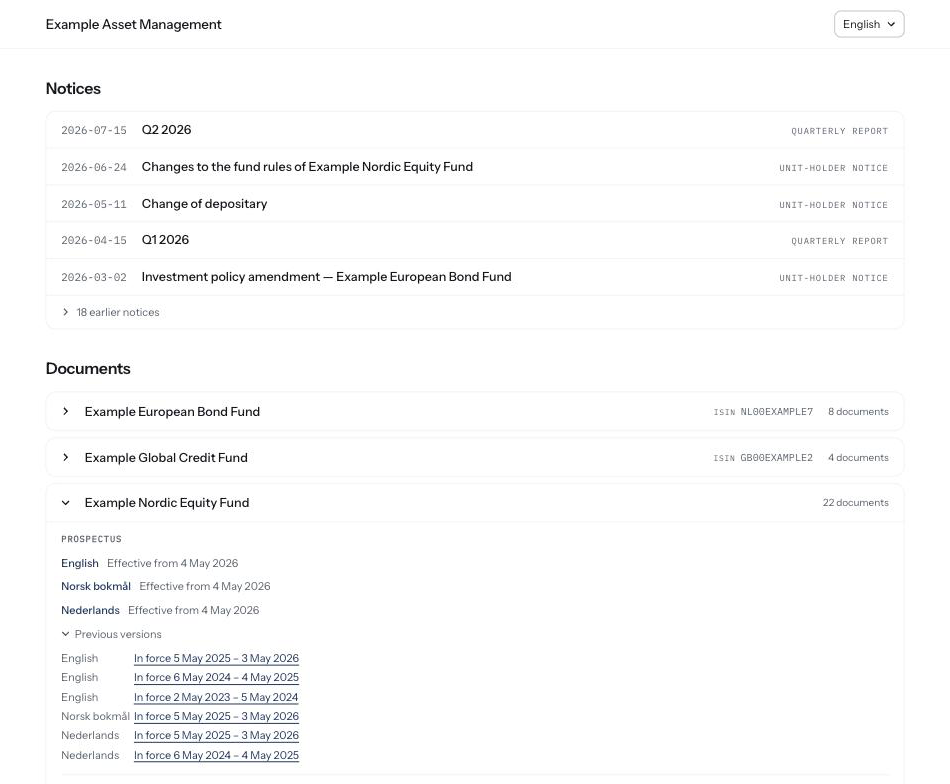
One page per publisher: notices at the top, then the products and the documents each one has, in every language you publish it in. Every earlier version is still there, listed with the period it was in force.
Who it is for
Same register, different vocabulary.
What differs between the pages below is the documents and who collects them — not the record underneath.
- Fund and AIF managersUCITS and AIFMD
Key information documents, prospectuses, reports and notices across funds, share classes and languages — at the addresses your templates and your distributors already point at.
- Crypto-asset issuers and offerorsMiCA
White papers and their modifications — each version kept with the dates it applied, and the earlier ones still reachable for the ten years MiCA asks for.
- Investment firmsIFR and SFDR
Prudential disclosures under IFR, and the sustainability disclosures that bind a firm managing portfolios or giving advice — each kept with the period it applied.
Why it exists
A file name is not a record.
A website puts a file where a browser can fetch it, and does that well. What it holds afterwards is a file name, an upload time and a folder — none of which say which document this is, which version it replaced, or the period it was in force.
So the record ends up outside the system that published it: in a spreadsheet, in an email thread, with whoever produced the document. That is a gap in the tool, not in the work.
What a website holds
- nordic-equity-a-2025-03.pdf
- Uploaded 14 March 2025, 09:41
- A folder it sits in
- The file it replaced, if it was not overwritten
What the register records
- Which document this is, and in which language
- In force from 12 March 2025 until 21 April 2026
- The version it supersedes, and from when
- One address, /d/XF0000000012-kid-en, unchanged across every version
Evidence
What was published on 14 June 2025.
The register answers two questions, not one: which document applies today, and which one applied on a date in the past. The second is the one that is hard to answer afterwards, and it is the one an auditor, a distributor or a supervisor asks.
Ask for a date and you get the documents that were current on it, each with its file hash, so whoever receives the answer can check it rather than take it on trust. A date in the future is never answered: scheduled publications are visible to you and to nobody else until the day they take effect.
Ask the register as at a date, and it returns the version that was current on it.
- Asked as at
- 2025-06-14
- Version returned
- 2025-03-12
- Validity period
- 12 March 2025 to 21 April 2026
- SHA-256
- 60d3487fc97d81180d33d924c4283afd7dafc0f925d1255cea51d0138679c69f
- Permanent address
- /d/XF0000000012-kid-en/2025-03-12
Getting started
Set it up yourself, or ask us to do it with you.
There is nothing to install and nothing to integrate. You can do all four steps from the panel — and if you would rather we did the first one, we will, and you check the result before anything is public.
Bring in what you publish today
Upload the documents already on your website. They keep the dates they carry, so the register starts with a history rather than an empty first day.
Approve the addresses
Each document is given an address. You see it and approve it before anything is public.
Update your existing references once
Change the links on your website, and the addresses you have reported to whoever collects them, to the new ones. This is the only time they change.
Publish to the same addresses from then on
A new version goes where the last one was. The previous version keeps its own dated address, and the change is recorded as it happens.
A good place to start is one product, or one set of the disclosures you publish in your own name. It is small enough to do in an afternoon and complete enough to judge.
Scope
What Kilospring does not do.
Written down because it decides how much of your firm has to look at us before you can say yes.
We do not produce, calculate or translate a document
We do not review, check or approve what a document says
We do not decide whether a review is due, or when one is
We do not replace your website
We do not file or submit anything to a regulator, a distributor or a data vendor
We do not change a file you have uploaded, ever
Files are held in storage restricted to EU jurisdiction, and we hold no personal data beyond your contact people. A file you upload is stored byte for byte and never altered. Ask us for everything we hold for you and you get it in full — the documents, the version history and the record of every change.
Try it with your own documents
Start with one set, and see the record.
Tell us how you publish today and we will write back with how the register would hold your documents. Nothing to install, nothing to commit to.
You can also write to info@kilospring.com.